Tag: Flying

  • Car seat on the plane in Canada: do you need one, by age, the CARES harness and Air Canada, WestJet and Porter rules

    Car seat on the plane in Canada: do you need one, by age, the CARES harness and Air Canada, WestJet and Porter rules

    This post contains affiliate links. If you book or buy through them, I may earn a small commission at no extra cost to you.

    Flying from Canada with a baby or a toddler and wondering if you need a car seat on the plane? Here is what you need to know: when your child needs their own seat, which car seats are approved for aircraft, what the CARES harness is, and the car seat rules at Air Canada, WestJet and Porter, checked on their own sites and on Transport Canada’s site in October 2026, plus what we actually do with our car seat.

    Do you need a car seat on the plane?

    In Canada, a child under 2 can fly on your lap, so a car seat on the plane is a choice and the rules do not force it. Transport Canada says child restraint systems are not mandatory on Canadian flights, and they have been allowed since 1990. Transport Canada also quotes the international aviation position that the safest option for a young child is the right sized, approved car seat in their own seat, and Air Canada recommends a restraint device for babies under 2.

    To be honest with you, I have never used a car seat in an airplane. With a baby, I use a baby carrier through the airport and on the plane, and my babies would always sleep in it. On our Etihad flight from Abu Dhabi to London, UK, we checked the car seat and the stroller and kept only the baby carrier for a comfortable sleep on the plane. On Emirates, they gave us a bassinet for free. Here are my tips for flying with a 2 to 4 month old baby.

    You know your children better than anyone, so take the tips and do what feels right for your family. More on that in the conflicting advice on how to travel with kids.

    When does a child need their own seat on a plane in Canada?

    Air Canada, WestJet and Porter all follow the same simple line: under 2, your child can be a lap infant, and from age 2, your child needs their own seat.

    • Under 2: a lap infant needs a ticket, but on Air Canada flights within Canada there is no charge, between Canada and the US only the taxes apply, and on international flights the lap infant pays 10% of the adult fare. WestJet and Porter do not charge a base fare or taxes for a lap infant on most routes, although some fees can apply on flights to the US and some international destinations.
    • One lap infant per adult: Transport Canada does not allow one person to be responsible for more than one infant on board, so twins need 2 adults aged 16 or older.
    • From age 2, or under 2 with a car seat on board: your child needs a paid seat.

    If your baby turns 2 during the trip, WestJet says you buy the return flight at full fare, Porter lets you buy a seat for the return only, and Air Canada asks you to call Air Canada Reservations on an international trip. A lap infant still needs their own passport for an international flight, so here is how to get a baby passport in Canada, step by step.

    Car seat on the plane by age: baby, toddler and 2 to 4 year old

    The airlines go by weight and by the limits printed on your car seat more than by age.

    A baby on the plane

    A rear-facing infant seat is made for the smallest babies. Transport Canada describes infant restraint systems as rear-facing and meant for babies under 10 kg (22 lb), and Air Canada says rear-facing devices are generally for babies under 9 kg (20 lb). Your baby can also fly on your lap in a carrier, or in a bassinet if your airline has one.

    A toddler or a 2 to 4 year old on the plane

    Air Canada says forward-facing devices are generally for children from 9 kg to under 30 kg (20 to 65 lb), always within the limits on the seat itself. From about 10 kg (22 lb), the CARES harness becomes an option, and from age 2 your child can also just use the aircraft seatbelt. Booster seats are the one thing you cannot use on board.

    Which car seats are approved for airplanes? Look for the sticker

    Look for the labels on your car seat before you go to the airport, because the airline will ask for an approved seat.

    • A car seat made in Canada: it needs the National Safety Mark showing CMVSS 213 for a child seat or CMVSS 213.1 for an infant seat. A Canadian seat with a label saying it is not certified for use in aircraft is not accepted.
    • A car seat made in the US: it needs the FMVSS label and the label saying “This restraint is certified for use in motor vehicles and aircraft”. Air Canada describes that second label as red.
    • A car seat made in Europe or the UK: it needs the ECE R44 or R129 approval and a label saying it is for use in aircraft.
    • A car seat made in Australia or New Zealand: it needs the AS/NZS 1754 label and the green aircraft label.

    The seat also has to fit between the armrests and be installed with the aircraft seatbelt. Porter gives about 17 inches wide as general guidance, so measure your seat before you fly.

    Booster seats and booster cushions are not allowed on board at Air Canada, WestJet or Porter, and Transport Canada says boosters are not approved as a child restraint in an aircraft. A combination seat has to be used with its own harness, says Air Canada.

    What is the CARES harness, and is it approved in Canada?

    CARES is a harness made by AmSafe that goes around the back of the aircraft seat and works with the seatbelt, so your child is strapped in without a car seat. It is FAA approved for aircraft use only, so it does not work in a car.

    Transport Canada reviewed the CARES device and accepts it on Canadian aircraft, for children between 10 and 20 kg (22 and 44 lb) and 100 cm (40 in) tall or less. Using it with a baby under 2 needs a national exemption, which the airline has to confirm.

    • Air Canada: accepted for children who can sit upright, but never in Signature Class, and it does not easily fit on the Dash 8-100 and Dash 8-300.
    • WestJet: accepted with the CARES and FAA approved label, always with the seatbelt.
    • Porter: accepted for children aged 1 and older.

    If you choose CARES, you still need a car seat at the destination if you are driving, so think about the whole trip before you choose.

    Air Canada, WestJet and Porter car seat rules

    Air Canada

    • Child restraint devices are not permitted in Signature Class, with some exceptions, so call Air Canada Reservations if you are flying in that cabin.
    • You can bring the restraint device on board in addition to the infant’s carry-on only if you bought a seat for the child.
    • One car seat or booster seat per child up to age 11 can be checked for free, on top of your baggage allowance, and it cannot have other items inside.
    • One stroller per child flies free. Small strollers, folded no larger than 25.5 cm by 92 cm, can be checked at the counter or at the gate, and a gate-checked stroller comes back to you at the aircraft door.

    WestJet

    • A child in a car seat needs a purchased seat, and WestJet asks you to call them so they can prepare your reservation for a car seat.
    • Car seats cannot be used in the Business section.
    • Rear-facing seats usually go by a window, and children in car seats cannot sit in over-wing exit rows or bulkhead seats. The child sits next to a guest aged 12 or older.
    • You can check 2 pieces of infant or child equipment for free, like a stroller and a car seat, and gate check them. If you use a car seat on board, you get one more piece of equipment on top of that.

    Porter

    • Lap infants are from 7 days old to under 2.
    • Porter does not supply car seats. If you bring one on board, you buy a seat for your child.
    • The car seat goes by a window, with an adult aged 16 or older beside it, and never in an emergency exit row.
    • A car seat and a collapsible stroller are checked for free, on top of your baggage allowance.

    Rules change, so open your airline’s car seat page again the week you fly. Here is how I rate airlines for a family trip in economy.

    Should you check, gate check or bring the car seat on board?

    Your baby gear flies free on most airlines: the stroller and the car seat are usually checked for free, so do not pay extra, just ask at check-in. We have checked our car seat and stroller for free on Air Canada, Emirates and Etihad.

    On our weekend trip to Atlanta, Georgia, I gate checked our YOYO stroller and checked the toddler Diono car seat. On our Flair Airlines flight from Toronto Pearson to Fort Lauderdale, Florida, kids got 2 free gate-check items, like a stroller or a car seat. Here is our weekend guide to Atlanta with kids.

    Checked at the counter, your hands are free and the car seat goes through the full baggage system, so it needs a bag. Gate checked, you keep it until the door of the plane. On board, you need a paid seat and an approved car seat. If you are flying solo, here is how to travel alone with your kids, and my 10 airport tips for flying with kids.

    Do you need a car seat bag for flying?

    I saw way too many broken strollers and uncovered car seats at baggage claim, so if you are checking a stroller or a car seat, protect it. A proper travel bag protects it from dirt, scratches and rough handling, and you spot it faster at baggage claim.

    For infant car seats, I usually recommend the brand’s own bag when the company offers one, because damage to a car seat is not always visible right away. For our trip from Toronto to New York and then to Abidjan, Ivory Coast (Côte d’Ivoire), our car seat and stroller went in their UPPAbaby travel bags, and we got them back at our destination.
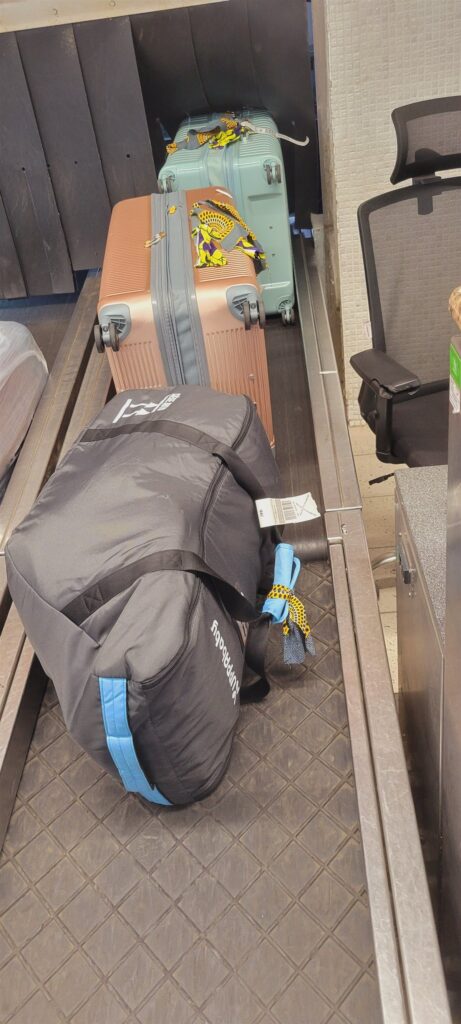
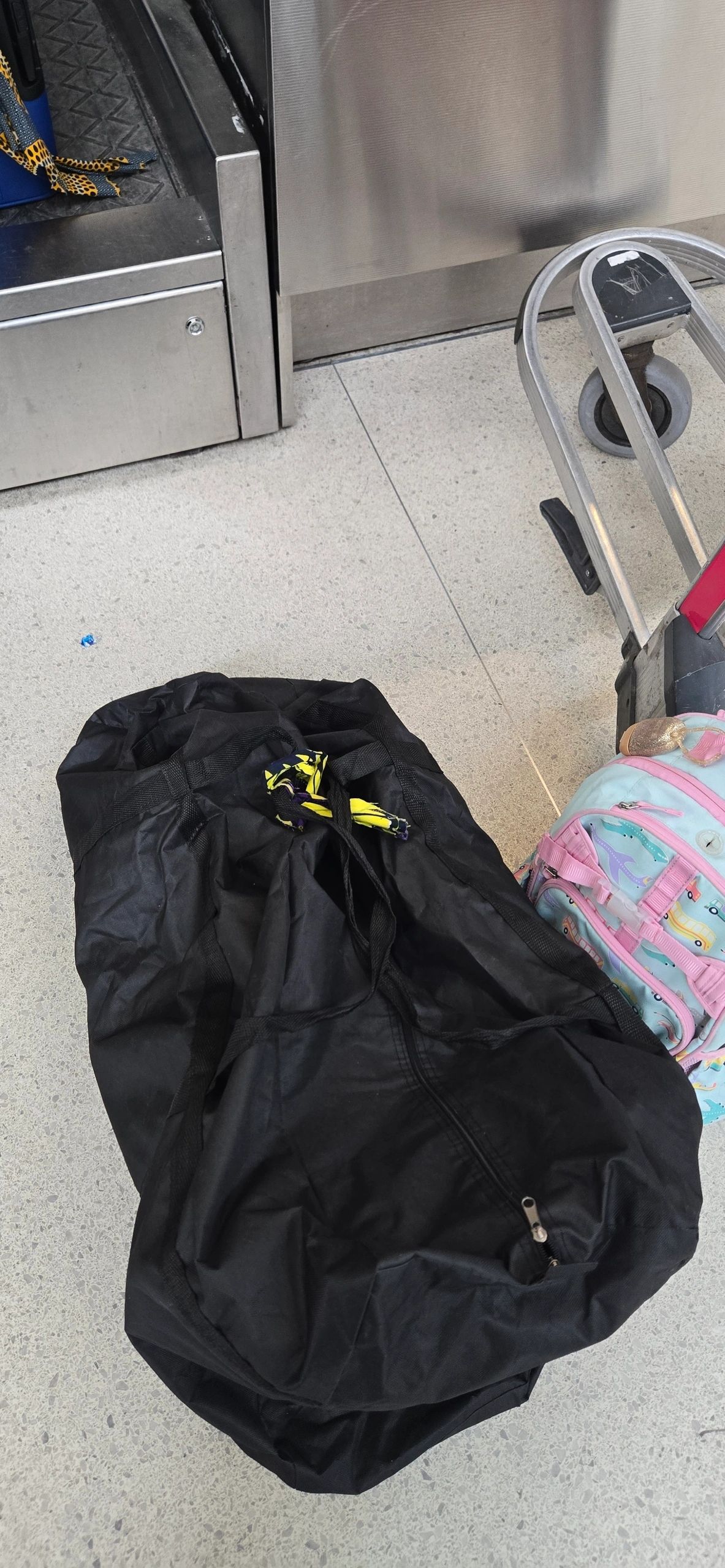
    Our car seat in its travel bag on the check-in belt at the airport in Abidjan, Ivory Coast (Côte d'Ivoire)

    All my tips are in how to protect your stroller and car seat when flying with kids, and the bags and accessories I use are in my car seat and stroller accessories list on Amazon.

    Car seats at your destination: rental cars, taxis and airport transfers

    When we went to Abidjan, Ivory Coast (Côte d’Ivoire), we had a car waiting for us when we left the airport, and we brought our own car seat from home. Here is my full guide to Abidjan with kids.

    • Airport transfers: book a private transfer from the airport to the hotel, because kids are usually tired after a flight. When you book a transfer on Kiwitaxi, you choose the type of child seat in the booking form: an infant seat up to 10 kg, a child seat for 9 to 18 kg or a booster for 15 to 36 kg. Child seats cost extra, every child counts as a passenger, and Kiwitaxi says the driver can refuse the transfer if you did not book a seat.
    • Taxis: ask before you count on a taxi having a car seat,. In Jamaica, for example, ask for one when you book your transfer or bring your own. Here is my guide to Jamaica with kids and to Montego Bay airport with kids.
    • Rental cars: ask the rental company about a car seat when you book, and check the seat and its labels when you pick up the car, or bring your own. In Nassau, Bahamas, we used taxis from the airport, and they drive on the left there, so think twice before renting a car with a baby seat for a short stay. It is all in our 3 day Nassau itinerary with a baby.
    • Renting baby gear: some families rent the car seat, the stroller and the crib at the destination to travel lighter. Here is why you might rent baby equipment at your destination.

    If you are heading somewhere sunny for March break, here is my guide to March break 2027 with kids from Toronto, including why I book a private transfer from the airport to the resort.

    Tips for installing a car seat on the plane

    • Book the window seat for the car seat, with your seat right beside it. Transport Canada recommends the window and says a car seat should never block an exit or the way out for the people next to it, so the aisle seat and the exit rows are out.
    • Call the airline after you book. WestJet asks you to call so they can prepare your reservation for a car seat.
    • Read the aircraft instructions on your car seat and practise installing it with a lap belt only, since the aircraft seatbelt has no shoulder strap. Transport Canada says top tether straps are not used on aircraft, so stow them the way the manufacturer explains.
    • Use family boarding if your airline offers it, so you have time to install the car seat before the aisle fills up. We always use it.

    If the plan is for your kids to sleep, here is how I get my kids to sleep on a plane in economy, and what is in our carry-ons for an overnight flight.

    What I pack for trips like this

    The things I actually use are in my Amazon store: my packing essentials list and my electronic must-haves for travel list.


    If you are flying with a car seat soon, my pre-travel checklist is the list I run before every trip, and it is free. You can get it here.

    Flying with your kids and a car seat soon? Send me a message on Instagram and tell me where you are going.
  • How I get my kids to sleep on a plane in economy

    How I get my kids to sleep on a plane in economy

    This post contains affiliate links. If you book or buy through them, I may earn a small commission at no extra cost to you.

    Someone asked me how I get my kids to sleep on a plane. We are not in the business class flat beds yet, so everything here is from economy, and the answer changes with their age.

    Babies: on me, or in the bassinet

    When they were babies, they slept on me or in the bassinet. You have to request the bassinet with the airline, and it is better to request it and then check with them, because they do not have enough bassinets for everyone.

    Toddlers: their own seat, their head on me

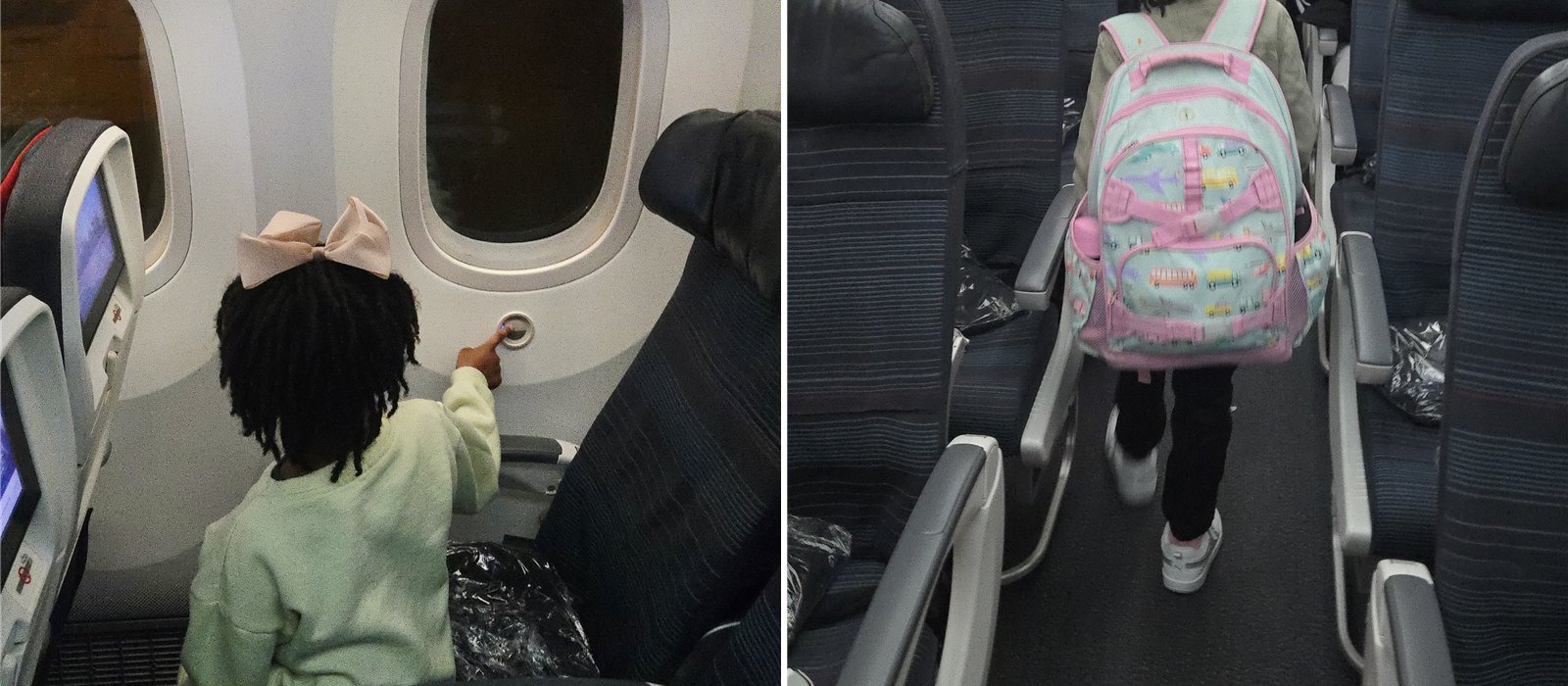
    Toddlers go in their own seat with their head on me. I take the window, I lean on it, and they lean on me. That is the whole setup, and it works on every flight.

    Around 3 to 5: an inflatable footrest

    Around 3 to 5, I used an inflatable footrest so their legs had something to rest on. I found mine on Amazon and used it on Air Canada. Not every airline allows it, and it also depends on the flight attendant, so check with your airline before you buy one. Here is how I compare airlines with kids.

    Comfy clothes, every single time

    We have a travel uniform: soft pants, a t-shirt, a sweater and socks, and shoes come off the moment we sit down. It is the same clothes in summer and in winter.

    A blanket, or a big scarf

    Bring a blanket, or a big scarf that doubles as one. Planes get cold, and a cold kid wakes up.

    What I pack for sleep on the plane

    The things I use are in my Amazon store: my baby and toddler sleep list, my 3 to 5 year old travel essentials and my plane travel essentials.

    More for the flight: 10 airport tips parents learn too late, keeping kids entertained on long flights and jet lag with kids.


    My free packing list is the list I use for every trip. You can get it here.

    How old are your kids and where are you flying? Tell me on Instagram and I will give you the version for their age.

  • Flying with kids: 10 airport tips parents learn too late

    Flying with kids: 10 airport tips parents learn too late

    This post contains affiliate links. If you book or buy through them, I may earn a small commission at no extra cost to you.

    Flying with kids? These are the airport and flying tips parents learn too late. They are small things, but they make a big difference, especially on international flights. Plus how we handle the airport itself with kids.

    10 airport and flying tips parents learn too late

    1. Keep your boarding pass until you leave the airport

    Border control or airport staff can ask for it after landing.

    2. Keep your luggage tag after arrival

    You need the tag number to report delayed or lost luggage. Here is how to deal with lost luggage.

    3. Put your name and phone number inside your checked luggage

    If the outside tag gets removed, this helps the airline identify your bag.

    4. Take a photo of your checked bag with the tag visible

    It makes baggage claims faster if your luggage does not show up.

    5. Screenshot your boarding passes

    Airline apps crash, log you out, or do not load without Wi-Fi.

    6. Save your hotel address offline

    Immigration can ask where you are staying.

    7. Use the washroom right before boarding starts

    Taxiing and the seatbelt sign can keep you in your seat for 30 to 40 minutes.

    8. Keep the kids’ essentials under the seat, not in the overhead bin

    You will not be able to reach the overhead bin during taxiing or turbulence.

    9. Feed the kids before boarding, even if meals are served on board

    Delays happen, and kids’ meals often run out.

    10. Pack a full change of clothes for the kids and the parents in your carry-on

    It is not always the kids who need it.

    Airports are not waiting rooms

    One thing I learned after a lot of travelling with kids: airports are not waiting rooms. Kids are excited, they are out of their routine, they want to move and look at the planes. So instead of trying to make them sit quietly for hours, this is what we do:

    • Let them walk as much as possible before boarding.
    • Find a play area if the airport has one.
    • Use a lounge when it makes sense, for space, food and a reset. More on airport lounges with kids.
    • Give snacks before they get hungry, not after.
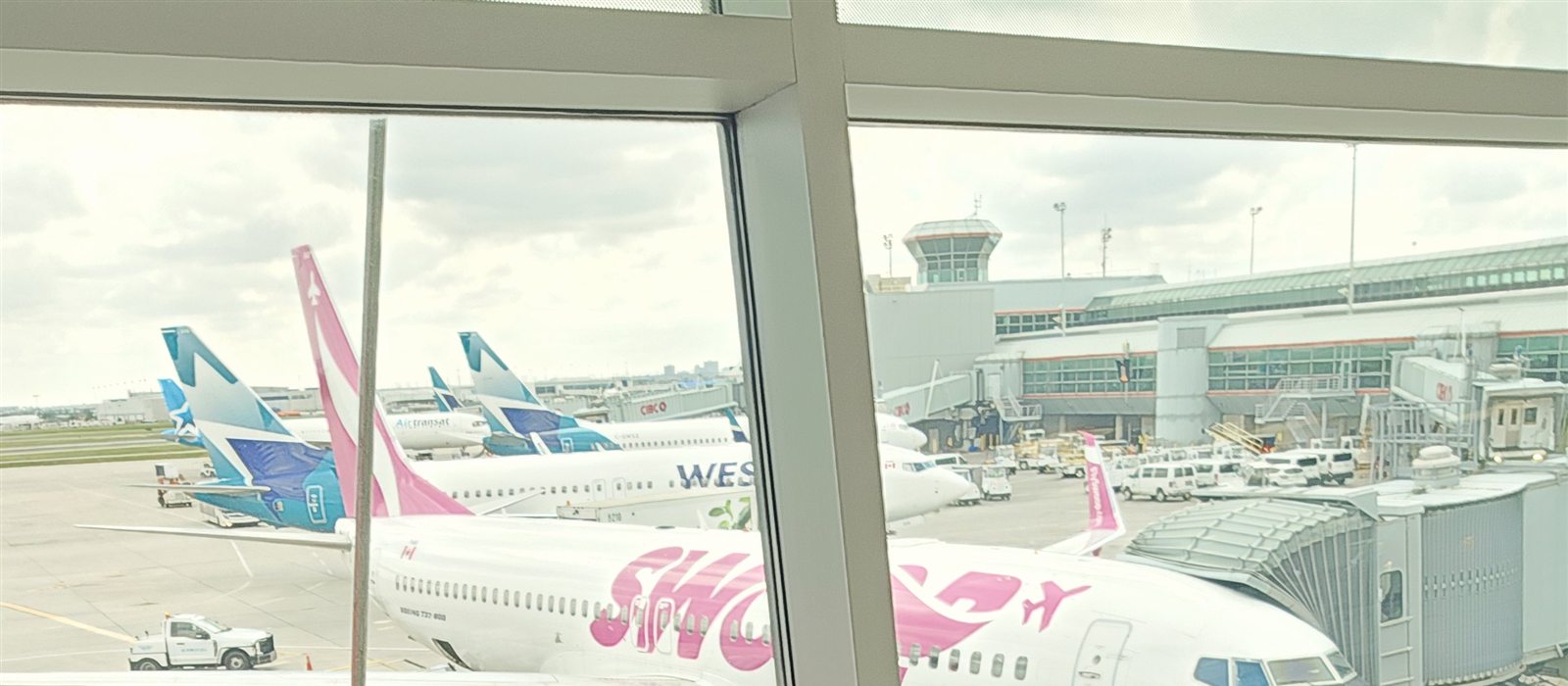
    • Window time: watching planes is free entertainment.
    • Screen time is okay on travel days.
    • Family boarding gives us time to settle without rushing. Here is why we always use it.

    I also prepare myself for the day to be a bit chaotic, and that is okay. Someone may have a meltdown, or need to pee right when we are lining up at security. That is part of the trip, and I try not to stress about it.

    More for your flight

    Bring an empty water bottle through security, keep kids entertained on long flights, and if you are flying solo, how to travel alone with your kids. If you need data when you land, you can set up an Airalo eSIM before you fly, and you can book your airport transfer with Kiwitaxi. My favourite travel products are in my Amazon store.


    My free packing list is the list I use for every trip. You can get it here.

    What is your best airport trick with kids? Tell me on Instagram.

  • Choosing an airline for a family trip: my economy ratings and tips

    Choosing an airline for a family trip: my economy ratings and tips

    This post contains affiliate links. If you book or buy through them, I may earn a small commission at no extra cost to you.

    Choosing an airline for your next family trip? Here is how I rate the airlines I have flown in economy with my kids, what to know about budget airlines, why we always use family boarding, and how kids can earn airline miles too.

    How I rate airlines in economy with kids

    This is the order I rated them in: Emirates, Etihad Airways, Air Canada, Air France, British Airways, Air Transat, Ethiopian Airlines, TAP Air Portugal, EasyJet and Ryanair. It is based on my experience flying these airlines, some of them multiple times, and focused on the onboard experience, not things like delays.

    What some airlines offer families

    • Family or priority boarding. We always use it.
    • 2 baby items checked for free, like a stroller and a car seat.
    • Family check-in counters at some airports.
    • A changing table in the airplane bathroom, usually.
    • Free Wi-Fi for members, on some airlines.
    • Blankets, headsets and snacks, sometimes free and sometimes paid.

    Food with kids

    Kids meals are not always automatic, so sometimes you need to request them. You can usually ask for free milk or for a bottle to be warmed.

    Comfort

    Some airlines have bassinets, which are limited, so request one early. Some have seat extenders for kids, but many do not, and seat comfort depends a lot on the aircraft.

    What I think about when booking a flight

    • The total travel time and the layover.
    • The flight timing.
    • The airline experience, so I know what to expect on the plane.
    • Points and the loyalty program.
    • And of course, the price.

    When you are ready to compare, you can search flights on Expedia.

    Flying a budget airline with kids

    Budget airlines get a bad rep and are not often the first choice, but here is what you should know. We flew round trip with Flair Airlines from Toronto Pearson to Fort Lauderdale. It was a 6am flight, so we prepped everything the night before: boarding passes downloaded, bags measured and tablets charged.

    • Bags: only a small personal item is free. Carry-on and checked bags cost extra, and adding a bag at the gate can cost double what it costs at booking. Measure at home, and pay when you book.
    • Onboard: drinks and snacks are for purchase only, including water. There are no blankets and no screens.
    • For parents: kids get 2 free gate-check items, like a stroller or a car seat, and a free diaper bag under 2.

    For a short flight with the kids, it worked, and the crew was super sweet, especially the pilots. For a long haul, I prefer the extra comfort. Here is what we did on that trip: a Miami day trip with kids.

    Why we always use family boarding

    I keep seeing people online saying family boarding is a scam, or that parents should always wait and board last. After 50+ international flights with my kids, I honestly do not agree. That extra 15 to 20 minutes on the plane has never made a real difference for us, especially on a long international flight.

    • Quiet time to settle in before the plane fills up.
    • Time to organize bags, snacks and toys before everyone boards.
    • Easy access to the overhead bin for carry-ons.
    • Empty aisles, which make it easier to walk to your seat with kids, backpacks and bags.
    • The kids get comfortable, look out the window, and love watching people board.

    When I travel solo with the kids especially, those calm setup minutes make a big difference. Every family travels differently, so do what works for your family.

    Kids can earn airline miles too

    Many parents only create loyalty accounts for themselves, but kids can have their own airline loyalty account, and once they start flying with a paid seat (usually around age 2), they can earn miles just like adults. Over time, miles can be used for free flights, seat upgrades or discounted tickets.

    • Create a loyalty account for your child.
    • Add their loyalty number when booking flights.
    • Try to fly within the same airline alliance when possible, so your points add up faster. The 3 main alliances are Star Alliance, SkyTeam and Oneworld. I personally stick with Star Alliance, because it includes Air Canada and many international partners.

    More on this in the secrets of travel loyalty programs, and for the flight itself, how to keep kids entertained on long flights, plus airport lounges with kids.

    What I pack for trips like this

    The things I actually use are in my Amazon store: my plane travel essentials list and my 3 to 5 year old travel essentials list.


    My pre-travel checklist is the list I run before every trip, and it is free. You can get it here.

    Deciding between airlines for your next trip? Send me a message on Instagram and tell me where you are flying.

  • What’s In Our Carry-Ons: An Overnight Flight With Kids

    What’s In Our Carry-Ons: An Overnight Flight With Kids

    This post contains affiliate links. If you book or buy through them, I may earn a small commission at no extra cost to you.

    Toronto to Helsinki is 8 hours, overnight, and I did it on my own with both girls. Everything below came on the plane with us. Our other bags went in the hold, which matters, because what you carry on is what you have if those bags don’t turn up.

    The thing that makes this work is not what I pack. It’s where I put it.

    I’ve put everything in this post on one Amazon list, so you can see the actual products instead of guessing from a photo: https://amzn.to/46S6edm

    The rule: pack by how fast you need it

    Most packing lists are sorted by category. Clothes here, toiletries there, snacks somewhere else. That’s fine at home and useless at 35,000 feet, because on a plane the only question that matters is how quickly you can reach something.

    So everything I bring is split across 3 places. On my body, a crossbody bag, reachable without standing up or opening a bin. Under the seat in front, the diaper bag, holding everything I’ll need during the flight. Overhead, the carry-on, holding everything I don’t need until we land.

    Sort by urgency instead of by category and you stop opening the overhead bin mid-flight, and you stop digging through a bag on your lap in the dark with a sleeping child on you.


    1. My crossbody, and it never leaves my body

    My hands stay free. When you are the only adult with 2 children, a stroller and a boarding pass, free hands are not a luxury. And everything important stays on my body. Passports, cards, the consent letter. None of it goes in the diaper bag and none of it goes overhead. If I had to get off a plane with one bag, this is the one, and I never want to be the person standing up to reach a bin because a border agent asked for a document.

    What’s in it:

    – Passports for all of us, and the boarding passes

    – The travel consent letter for children travelling abroad

    – Credit cards and a slim card holder

    – A blister pack of medication, hand sanitiser, wet wipes, tissues and mints

    – Lip gloss and cocoa butter cream

    – A power bank, wired earphones and a phone grip pad

    – A pen, for landing cards

    2. The diaper bag, under the seat in front of me

    This is the only bag I can reach without moving, so everything I’ll need during the flight lives here.

    – Diapers, baby wipes and snacks portioned into resealable bags

    – Kids Gravol for motion sickness, and pain relief for me

    – An empty water bottle

    – My scarf

    – A tray table cover, and a tote bag folded flat

    – Sunglasses, chargers and cables, and a compact travel power strip

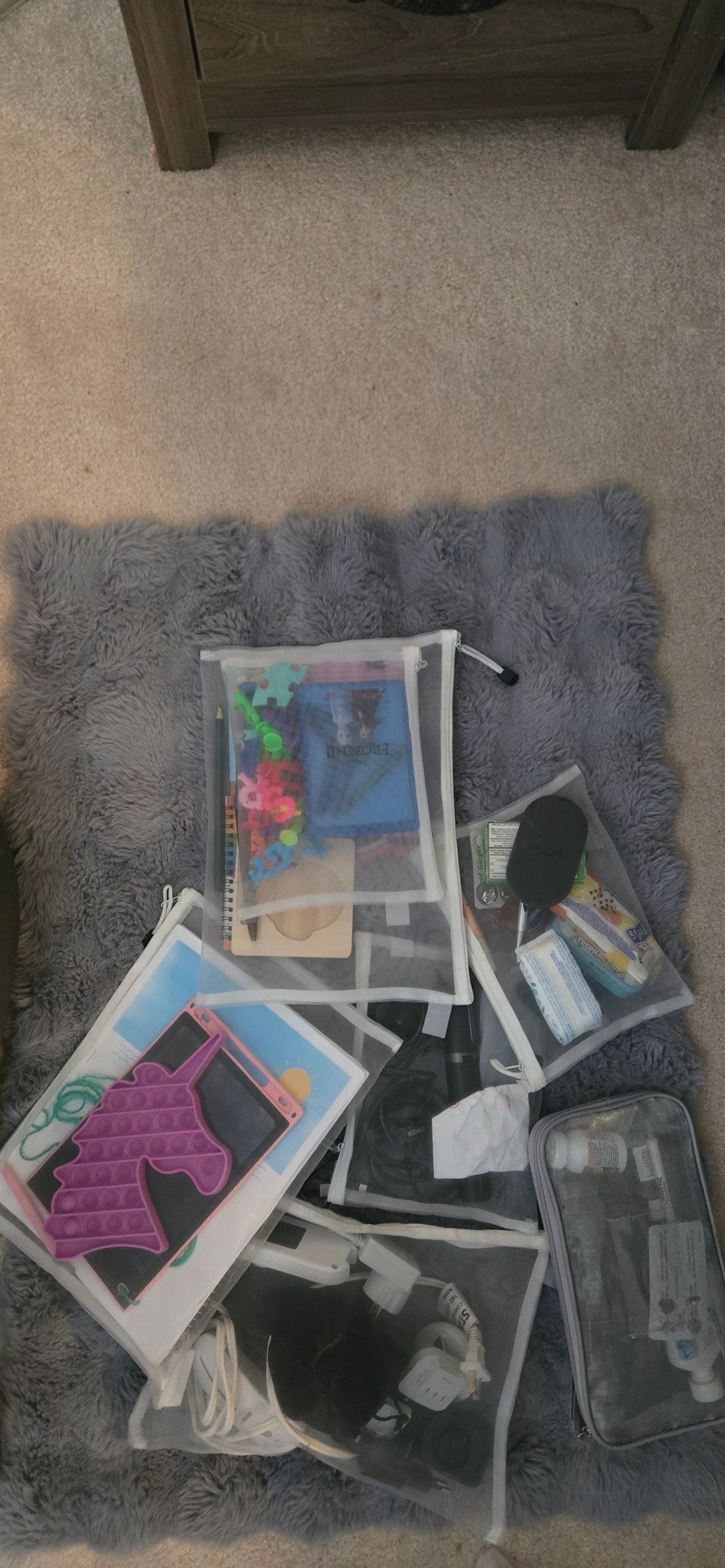
    – A reusable LCD writing tablet, foam alphabet letters, a small wooden puzzle and a scratch art notebook

    The 4 things in here that do the most work.

    The empty water bottle goes through security empty and gets filled on the other side. You skip the queue at the shop and you are not paying airport prices for water you’ll finish before boarding.

    The scarf is the one item I never fly without, and it’s the hardest working thing I own. It’s a blanket on the plane. It’s a blanket over the stroller. It’s a blanket when we’re sitting outside somewhere and the evening turns cold. And when I don’t need any of that, it’s a scarf. One thing doing 4 jobs is worth more carry-on space than 4 things doing one each.

    The tray table cover matters because tray tables are not as clean as they look, and on an overnight flight a child’s face ends up on one. It also holds the things that would otherwise slide into the seat pocket and get left behind.

    The power strip is for the airport, where the seating never has enough outlets. One plug becomes 3, which matters when you have a tablet, a phone and a pair of headphones all needing charge before an 8 hour flight.

    The exact scarf, power strip, tray table cover and snack bags I use are all on the Amazon list: https://amzn.to/46S6edm

    3. The carry-on, overhead

    This bag is insurance. I don’t open it until we land.

    – My laptop, and headphones in a hard case

    – 2 days of clothes for all 3 of us

    – Pyjamas for the first night, slippers and flip flops

    – Toiletries in a clear pouch: toothbrushes, toothpaste, body wash, creams

    – A packing cube, and the document folder

    Why 2 days of clothes, for all 3 of us. If our checked luggage doesn’t arrive with us, we are still fine for 2 days. That’s the obvious reason.

    The less obvious one matters more. Even when the luggage does arrive on time, we can land, get to where we’re staying, and go straight to bed without opening a single big suitcase. After an overnight flight with kids, nobody wants to unpack. Pyjamas and slippers in the carry-on means the first night costs you nothing.

    My laptop always stays with me. It never goes in a checked bag.

    Everything inside the carry-on goes into a clear zip pouch. Activities in one, toiletries in another, cables in another, the power strip in its own. I can see what’s in each one without opening a bag. That means nothing gets unpacked at security, nothing gets emptied onto a hotel floor at midnight, and I can hand a child exactly the pouch they need without going through everything.

    4. My 8 year old’s bag

    She’s 8, so she carries her own backpack. It’s hers, she knows what’s in it, and she manages it.

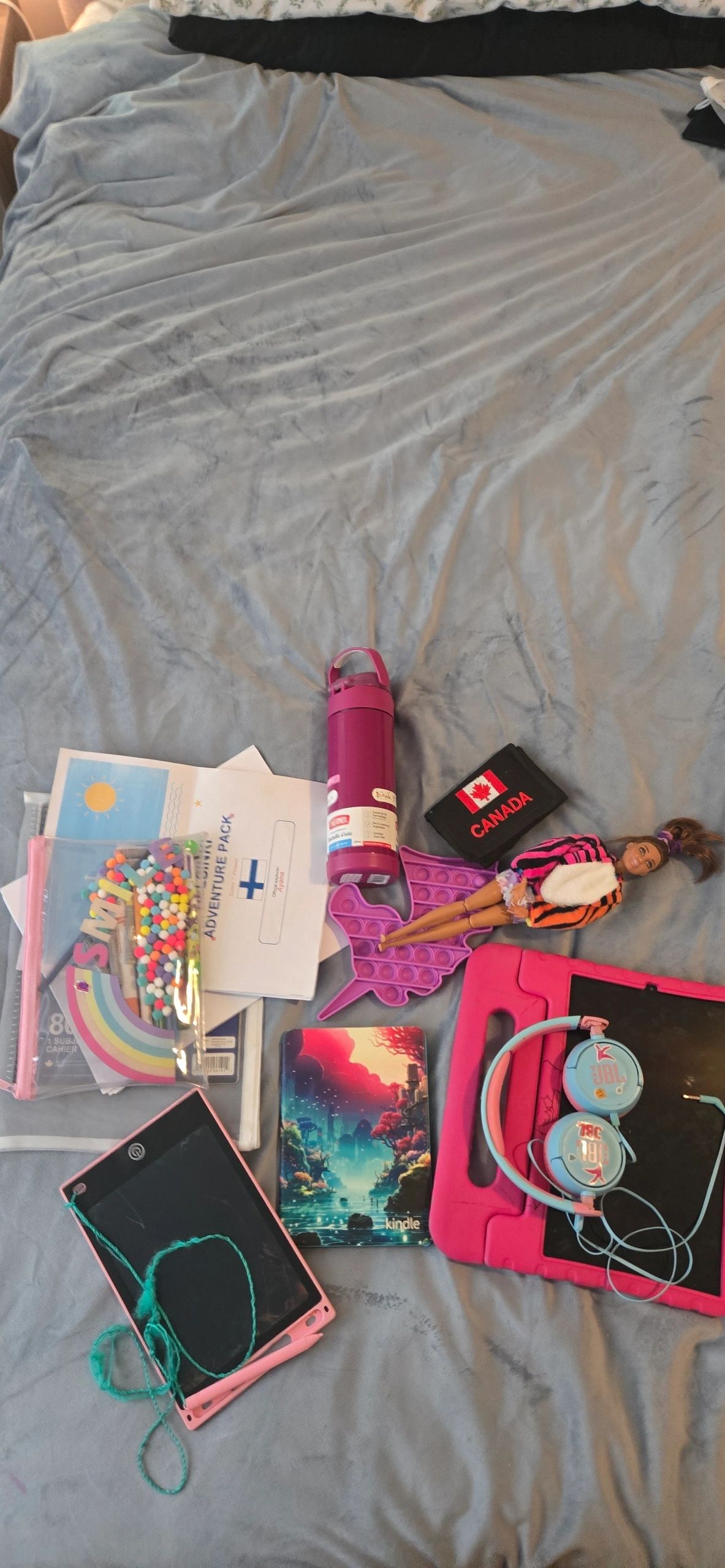
    – A Kindle, and a tablet in a protective kids case

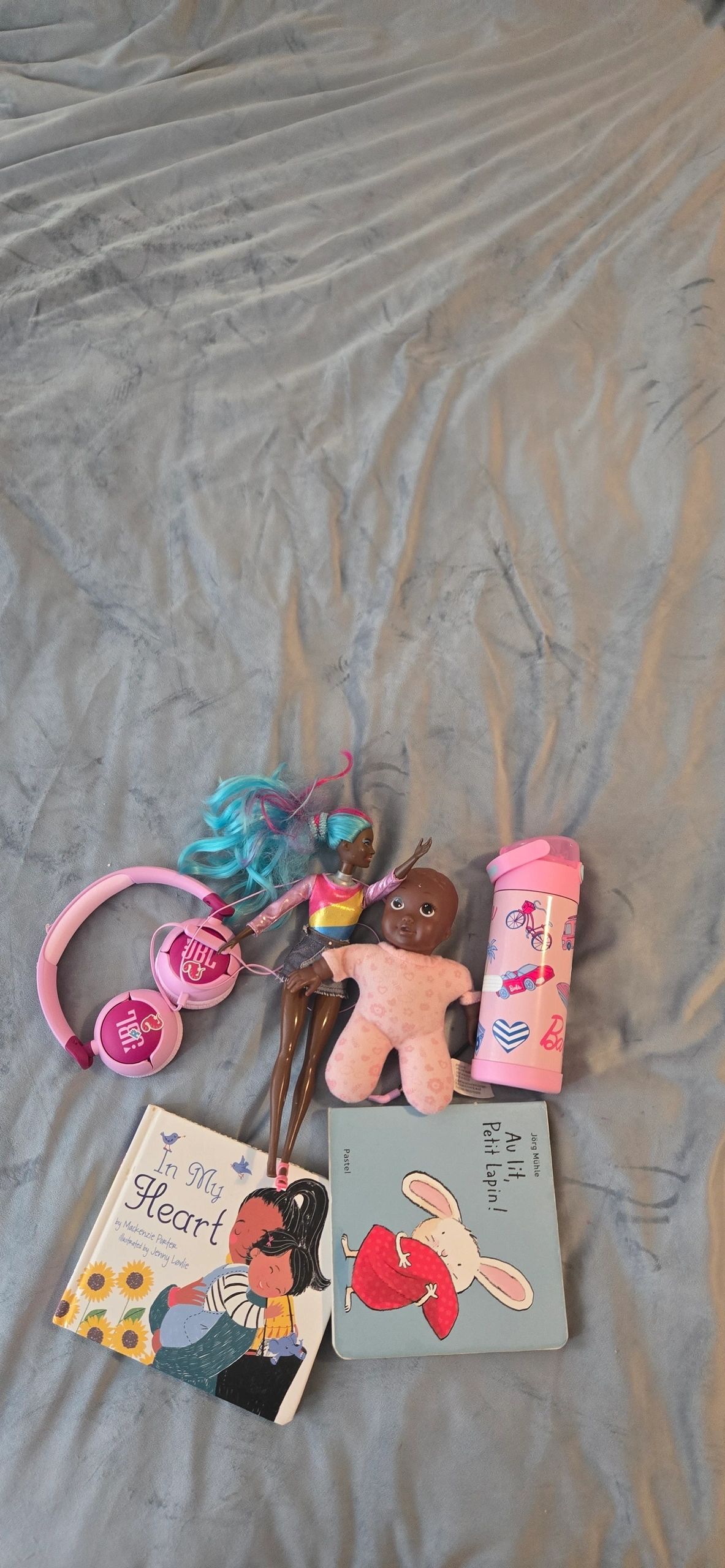
    – JBL headphones

    – An insulated Thermos bottle

    – A wallet, a pencil case and a notebook

    – A reusable LCD writing tablet with a stylus

    – A doll and a pop it

    – A printed adventure pack I made for the trip, with her name on it

    The adventure pack is the part I would keep if I dropped everything else. I made these to get them excited about Finland before we even left. They both have one, each at their own level, so the little one isn’t looking at something she can’t do and the big one isn’t bored by it. A trip starts before the plane does, and giving them something of their own to open turns a long travel day into part of the holiday.

    5. My 3 year old’s bag

    Small, light, and she carries it herself.

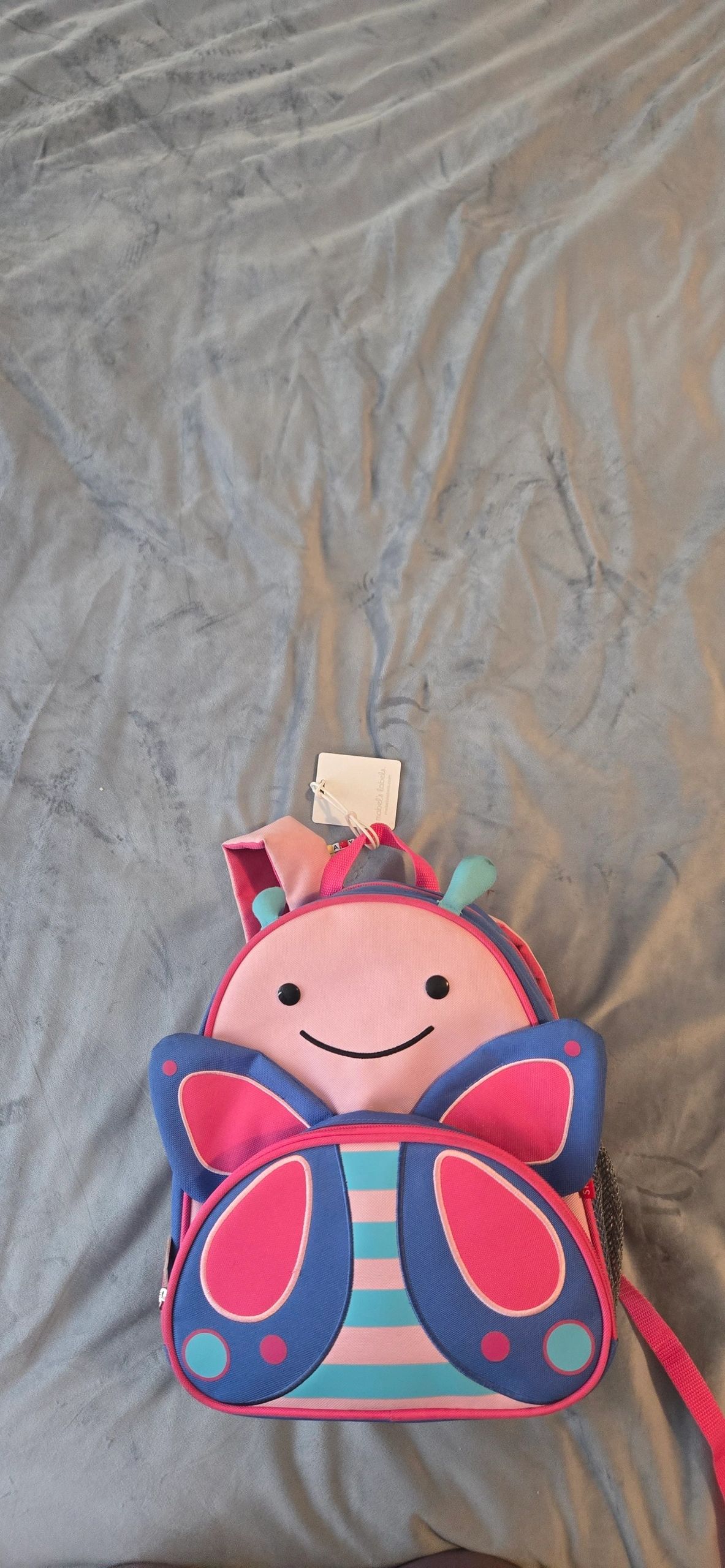
    – A Skip Hop butterfly backpack

    – Her own headphones and an insulated bottle

    – A doll and a soft baby doll

    – 2 books, one in English and one in French

    We read in both, and a flight is 8 uninterrupted hours of it.

    What's In Our Carry-Ons: An Overnight Flight With Kids

    On entertainment for an overnight flight

    I pack less than people expect. It’s overnight, so I’m hoping they sleep, and a bag full of activities you never open is weight you carried through an airport for nothing. The tablet still comes. I would rather have it and not need it.

    This is the part most packing lists get wrong. They give you the same list whether you’re flying at 9 in the morning or 9 at night, and those are completely different flights.

    What I pack for trips like this

    The things I actually use are in my Amazon store: my plane travel essentials list and my 3 to 5 year old travel essentials list.


    The full checklist

    Every product in this post, with the exact brands, is on my Amazon list, Carry-on essentials for flying with kids: https://amzn.to/46S6edm

    Everything above as a list you can tick off is in my free packing list: https://payhip.com/b/NPGmL

    And for the weeks before the trip, my pre-travel checklist is free too: https://payhip.com/b/cp71z

    What's In Our Carry-Ons: An Overnight Flight With Kids
    What's In Our Carry-Ons: An Overnight Flight With Kids
  • How to protect your stroller and car seat when flying with kids

    How to protect your stroller and car seat when flying with kids

    This post contains affiliate links. If you book or buy through them, I may earn a small commission at no extra cost to you.

    If you’re flying with kids and checking your stroller or car seat with your luggage, one simple mistake can cost you a lot: leaving it uncovered.

    After landing back in Toronto, I saw so many strollers at baggage claim scratched, dirty, damaged, and honestly just thrown around. Some looked bent, some were missing parts, and a few clearly had a very rough trip.

    As parents, we already spend enough on baby gear. Replacing a stroller or car seat because it got damaged at the airport is not the kind of vacation souvenir anyone wants.

    Here’s how I protect mine when I fly.

    What I pack for trips like this

    The things I actually use are in my Amazon store: my car seat and stroller accessories list and my baby travel essentials list. And my free pre-travel checklist is the list I use before every trip: you can get it here.


    Always use a travel bag or protective cover

    If you’re checking your stroller or car seat with your luggage, never leave it uncovered.

    A simple travel bag or protective cover helps protect against:

    • Dirt and stains
    • Scratches and broken parts
    • Rough baggage handling
    • Missing pieces
    • Easier identification at baggage claim

    It also makes pickup much easier because you can spot your item faster instead of searching through a pile of loose strollers.

    For infant car seats, I recommend the brand bag

    For infant car seats, I usually recommend using the actual brand bag if the company offers one.

    Brands like UPPAbaby have their own travel bags designed specifically for their car seats and strollers. They usually fit better, offer stronger protection, and in some cases, they even include travel coverage when you use their approved bag.

    That extra protection is worth it for something as important as a car seat.

    Damage is not always visible right away, and that’s not something I want to risk.

    For strollers, you don’t always need the expensive option

    For strollers, I usually just use a good regular travel bag.

    You do not always need the most expensive branded version.

    The goal is simple: protect your stroller before check-in so it can handle the rough baggage process.

    A strong travel bag that closes properly and keeps everything covered is often enough.

    Check-in luggage vs gate check

    This advice is for strollers and car seats that are checked with your luggage, not gate checked.

    If you are checking it at the main luggage counter, protection matters even more because it goes through the full baggage handling system.

    That is where most of the damage happens.

    Even if you gate check sometimes, I still prefer having a bag ready because airport handling is never gentle.

    My simple rule

    Protect your gear before check-in.

    It takes two extra minutes, but it can save you from replacing expensive baby gear later.

    Traveling with kids already requires enough planning. This is one small step that makes a big difference.

    And after seeing those broken strollers at baggage claim, I will always use a cover.

    Final thought

    If your stroller or car seat is expensive enough that replacing it would frustrate you, it deserves a travel bag.

    Simple.

    Because family travel should be stressful enough without arriving and realizing your stroller did not survive the flight.

  • Travel tip bring an empty water bottle through airport security

    Travel tip bring an empty water bottle through airport security

    This post contains affiliate links. If you book or buy through them, I may earn a small commission at no extra cost to you.

    Travel days with kids can be long, unpredictable, and tiring. One small habit that makes a big difference for our family is bringing an empty water bottle through airport security.

    It’s simple, free, and one of the easiest family travel tips for flying with kids.

    Why this matters when traveling with kids

    Airport water is expensive. Paying five dollars for a bottle of water adds up quickly, especially when you’re traveling as a family.

    Kids also get thirsty fast, often before the plane even takes off. Once you’re seated, drinks are not always served right away, and if the plane is delayed, it can take even longer.

    Having water ready helps avoid unnecessary stress and makes boarding and takeoff much smoother.


    Can you bring a water bottle through airport security

    Yes. As long as the bottle is empty, you can bring it through airport security.

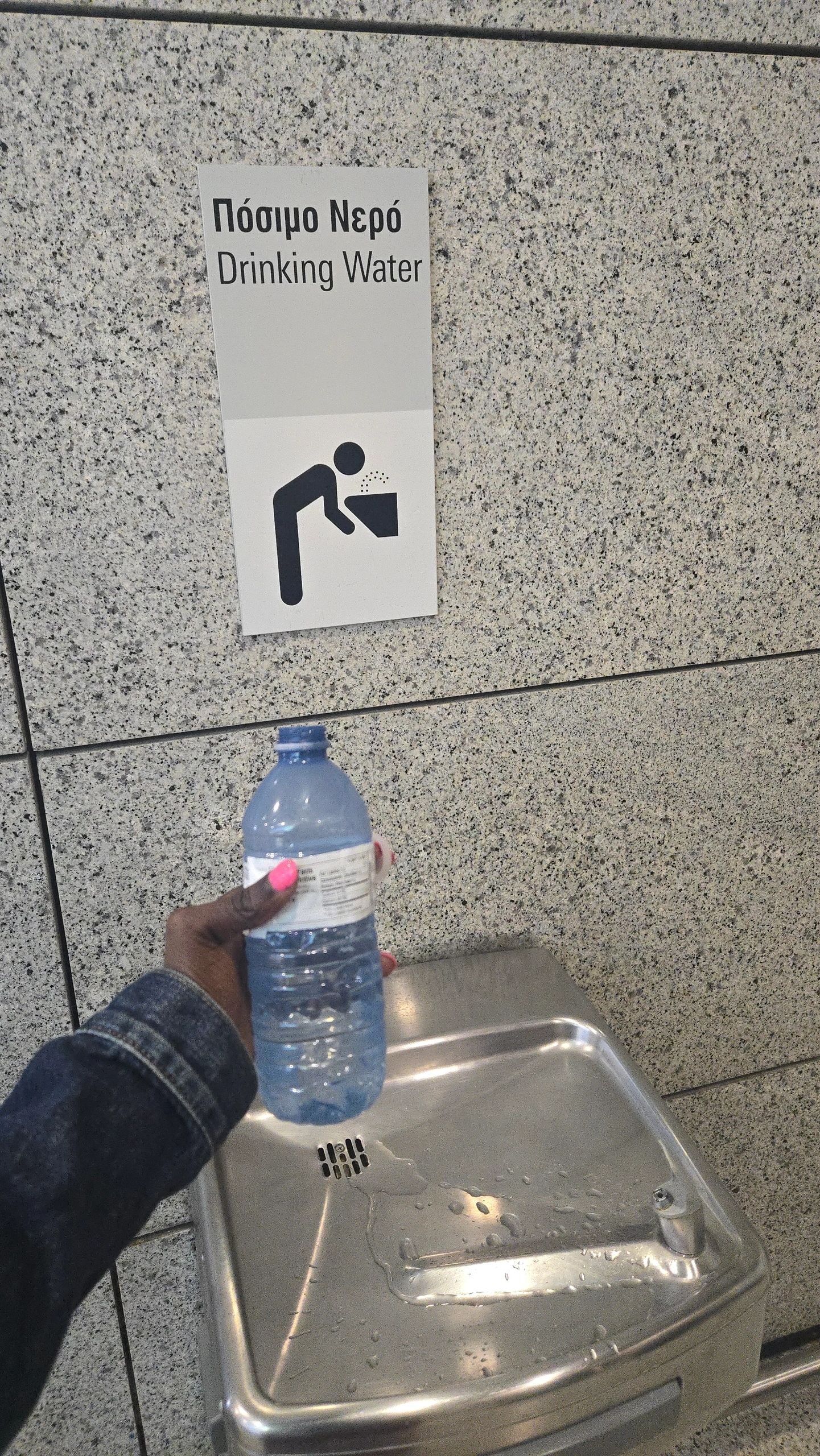
    Once you’re past security, most airports have water fountains or refill stations where you can fill it up before boarding. This is an easy carry on essential for both kids and parents.

    Traveling with kids under 2 and liquids

    If you’re traveling with children under 2, you’re usually allowed to bring liquids like water, milk, formula, or juice through security.

    That said, rules can change depending on the airport and the country, and security may ask to inspect or test liquids. It’s always a good idea to check the airport or airline guidelines before you travel and allow a little extra time at security.

    Even when liquids are allowed, bringing an empty bottle is still helpful once you’re past security.

    What I pack for trips like this

    The things I actually use are in my Amazon store: my plane travel essentials list and my 3 to 5 year old travel essentials list. And my free pre-travel checklist is the list I use before every trip: you can get it here.


    Why this helps on family flights

    Flights get delayed. Boarding takes time. Airports are dry environments. All of this makes hydration even more important, especially for young children.

    Having water on hand means fewer complaints, fewer meltdowns, and a calmer start to the flight. It’s a small thing, but it makes flying with kids feel much more manageable.

  • Airport Lounges with Kids: Everything Parents Need to Know

    Airport Lounges with Kids: Everything Parents Need to Know

    This post contains affiliate links. If you book or buy through them, I may earn a small commission at no extra cost to you.

    Travelling with kids can feel like a marathon (and it feels like it!), from keeping everyone fed to managing meltdowns before you even board the plane. One of my favorite ways to make airport days smoother is using airport lounges.

    I first discovered lounges years ago when I travelled often for work. As an Aeroplan Elite and Star Alliance Gold member, I had access to lounges all over the world. I loved them so much that I would sometimes arrive at the airport early just to enjoy the food, relax, or even take a shower before my flight.

    Now that I travel with kids, lounges are no longer just a nice perk; they’re a lifesaver. Here’s everything parents need to know about airport lounges when flying with little ones.


    What Is an Airport Lounge?

    Airport lounges are private areas inside the airport where travelers can rest, eat, and recharge before their flight. They’re quieter, cleaner, and more comfortable than the main terminal.

    There are different types of lounges:

    • Airline lounges (like Air Canada’s Maple Leaf Lounge) — usually for frequent flyers or premium ticket holders.
    • Independent lounges (like Plaza Premium) — open to anyone for a fee.
    • Membership lounges (like Priority Pass) — available with a yearly membership or day pass.
    Airport Lounges with Kids: Everything Parents Need to Know

    Do Lounges Allow Kids?

    Yes — most lounges welcome families, but the rules vary.

    • Children under 2 are usually free.
    • Some lounges may charge a reduced child fee.
    • A few even have family rooms or play areas designed for kids.

    Tip: Always check the specific lounge policy before traveling.


    What’s Included in a Lounge?

    When you step into a lounge, here’s what you can typically expect:

    • Meals and snacks → hot and cold food, drinks, and sometimes even barista coffee.
    • Comfortable seating and space → a relief when your kids want to move around.
    • Bathrooms and change tables → usually much cleaner than those in the terminal.
    • Wi-Fi and charging stations → download shows and top up devices before boarding.
    • Extra perks → some lounges offer showers, nap rooms, or kids’ play zones.

    How to Get Lounge Access (Free or Paid)

    You don’t need to be a business traveler to enjoy lounges. Here are the main ways families can get access:

    1. Travel credit cards (Free/Included)
      Many premium travel credit cards include complimentary lounge passes each year. For example, my CIBC Aeroplan card gives me a set number of free visits (in Canada).
    2. Frequent flyer status (Free/Included)
      Higher status with airlines (like Aeroplan Elite or Star Alliance Gold) often comes with free lounge access.
    3. Business or first class ticket (Included in ticket price)
      If you book a premium ticket, lounge entry is usually included.
    4. Points or miles (Redeemable)
      You can use your loyalty points or miles to cover the cost of entry.
    5. Day pass or Priority Pass membership (Paid)
      Buy a single-use pass (usually $30–$50 per person) or join a program like Priority Pass for ongoing access.
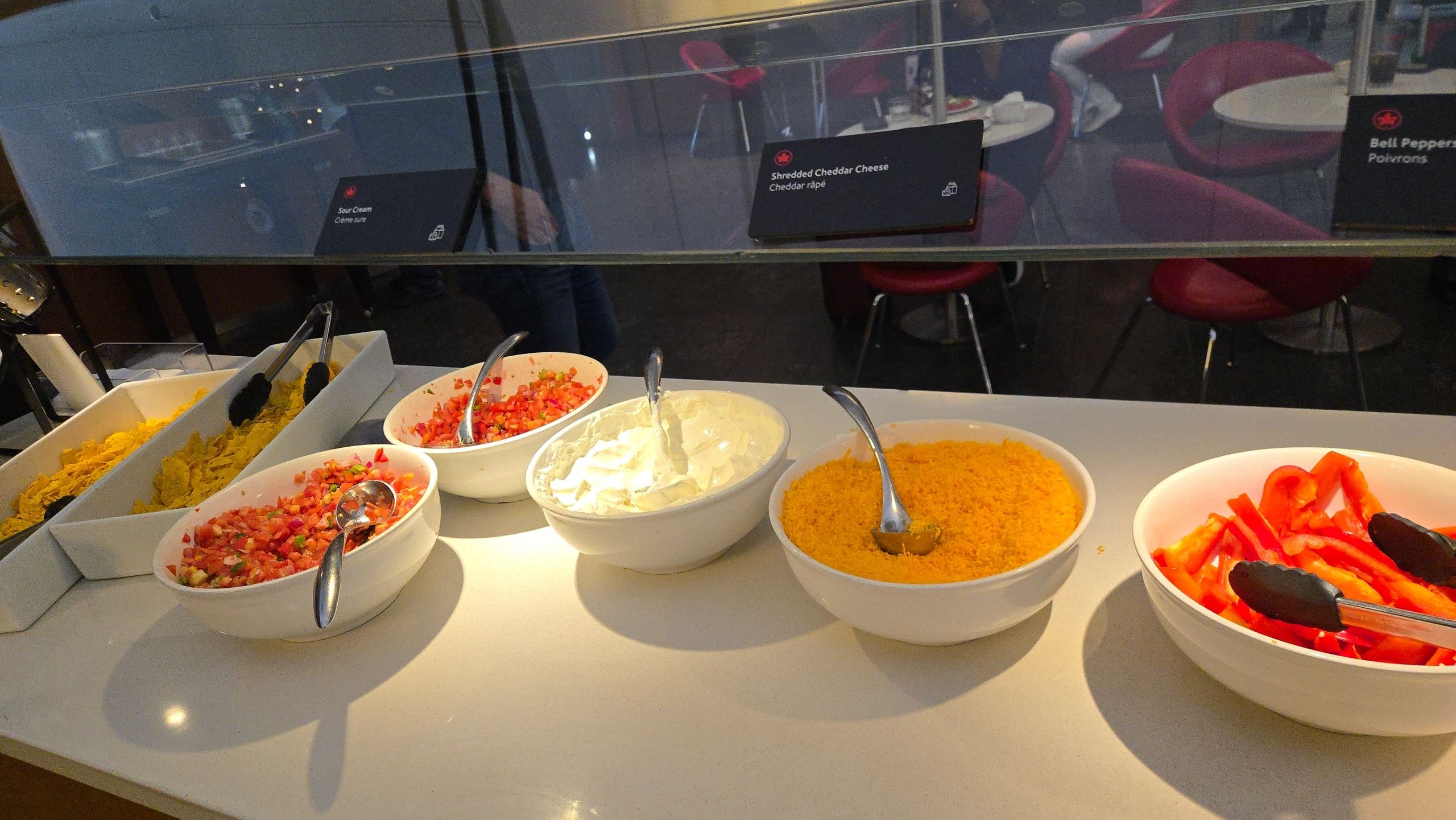
    Air Canada Lounge - Toronto

    Why Lounges Are a Lifesaver for Parents

    Lounges make traveling with kids so much easier:

    • Meals and snacks included → no need to spend on overpriced airport food.
    • Extra space → kids can stretch, walk around, and burn off energy.
    • Cleaner bathrooms and changing tables → easier for parents with babies and toddlers.
    • Calm atmosphere → gives kids (and parents!) a break from the chaos.
    • Wi-Fi and charging → perfect for last-minute downloads or topping up tablets.

    Parent Tips to Maximize Your Time in the Lounge

    • Arrive a little earlier → so you can actually enjoy it.
    • Pack up a few snacks → great to bring onboard for picky eaters.
    • Bathroom and diaper changes → always easier before boarding.
    • Fill bottles and sippy cups → saves time on the plane.
    • Download shows using lounge Wi-Fi → keeps kids entertained during the flight.
    Airport Lounges with Kids: Everything Parents Need to Know

    What I pack for trips like this

    The things I actually use are in my Amazon store: my plane travel essentials list and my 3 to 5 year old travel essentials list. And my free pre-travel checklist is the list I use before every trip: you can get it here.


    Final Thoughts

    Airport lounges aren’t just for business travellers anymore — they’re a smart way for families to make flying less stressful. Whether you get in with a credit card, points, or a one-time pass, the comfort and convenience can make a huge difference when you’re traveling with kids.

  • 5 Simple Tips for Navigating Airport Security with Kids

    5 Simple Tips for Navigating Airport Security with Kids

    This post contains affiliate links. If you book or buy through them, I may earn a small commission at no extra cost to you.

    Traveling with young kids can feel overwhelming, but with a bit of planning and patience, getting through airport security can be much smoother. I’ve learned this firsthand from years of frequent flying.

    Before having kids, I used to travel for work every week and practically lived in airports. Once I started traveling with my little ones, I knew I had to step up my airport game. Over the years, I have taken countless flights with my kids and can confidently say I’ve mastered the art of navigating airport security with children in tow.

    Here are my top tips to make it easier for you:

    What I pack for trips like this

    The things I actually use are in my Amazon store: my plane travel essentials list and my 3 to 5 year old travel essentials list. And my free pre-travel checklist is the list I use before every trip: you can get it here.


    1. Organize Your Bags and Know Airline Policies

    Before you even head to the airport, make sure your bags are organized. Use clear bags for liquids, electronics, and baby food so they can be easily accessed during screening. Know your airline’s policies on strollers, car seats, and carry-ons. Some airlines allow you to gate-check strollers and car seats for free, but it’s always good to check in advance to avoid surprises.

    Quick Tip: Use a protective bag for your stroller or car seat when gate-checking to keep them clean and safe during handling.

    2. Arrive Early and Use Family-Friendly Security Lines

    With kids, everything takes a little longer. Arriving early gives you extra time to get through each step of the process without rushing. Many airports also offer family-friendly security lines, which are typically less rushed and more accommodating to parents with young children. These lines allow you to take your time and avoid feeling pressured.

    Quick Tip: Research if the airport you’re flying from has a designated family lane to save time and reduce stress.

    3. Dress Smart for Security

    Make it easy on yourself by wearing shoes that are simple to remove and put back on. This is especially helpful when you have your hands full with kids. Also, using a baby carrier can be a lifesaver—keeping your hands free to handle luggage and documents while keeping your baby close.

    Quick Tip: Dress your kids in shoes and clothes that are easy to manage as well, especially if you need to remove jackets or layers for the security check.

    4. Inform Security About Baby Food and Formula

    If you’re traveling with formula, breast milk, or baby food, inform security as soon as you arrive at the checkpoint. While the usual liquid limits don’t apply to baby items, they may need to be screened separately. Make sure they’re in clear, easily accessible containers to speed up the process.

    Quick Tip: You can bring more than 100ml of liquids for your baby’s needs, but pack them in a way that makes it easy for security to inspect without unpacking everything.

    5. Stay Calm and Keep Kids Entertained

    Kids pick up on your energy, so staying calm can help them stay relaxed too. Bring along small toys, books, or a tablet to keep your little ones entertained while waiting in line or during the security process. Patience is key—try to remain composed, even if things take longer than expected.

    Quick Tip: Keep snacks handy! A well-timed snack can keep kids occupied while you go through security.

    Bonus Tip: Use the Left Security Lane

    One of the best tips I’ve learned from years of flying is that people tend to automatically go to the right when they approach the security lines. I always head to the left lane, which is usually less crowded and moves faster. It’s a small trick, but it can save you a lot of time!

  • Flying with Baby Formula, Food, and Milk. Your questions answered

    Flying with Baby Formula, Food, and Milk. Your questions answered

    This post contains affiliate links. If you book or buy through them, I may earn a small commission at no extra cost to you.

    Traveling with a baby can be a challenging experience, but with a little planning, you can make it much easier—especially when it comes to packing baby essentials like formula, food, and milk. Here’s a complete guide to help parents navigate the rules, packing tips, and extra advice for flying with baby food and formula stress-free.

    I am sharing the link to my Amazon Store with my favourite feeding products I use

    My free travel with a baby guide is the list I use for every trip. You can get it here.


    1. Can I Bring Baby Formula, Food, and Milk on a Flight?

    Yes! You are allowed to bring baby formula, breast milk, juice, and baby food on board in quantities that exceed the usual 3.4-ounce (100 milliliters) liquid rule. TSA and most airport security worldwide allow you to bring what you reasonably need for the flight and time at your destination.

    The key here is to pack enough, but not too much, to avoid unnecessary delays at security. You can confidently pack what your baby will need during the trip, and it will be exempt from the standard liquid restrictions.

    2. How Should I Pack Formula, Food, and Milk for a Flight?

    Packing your baby’s essentials the right way can make the trip much smoother. Here are some key tips for packing:

    • For Formula and Milk:
    • Use pre-measured containers for powdered formula to save time during the flight.
    • Pack bottles or sippy cups filled with the correct amount of liquid for your baby. Be sure to pack an insulated bag with ice packs to keep milk fresh.
    • For Baby Food:
    • Bring a variety of baby food in jars, pouches, or resealable containers. Keep snacks like crackers or fruits in separate containers for easy access.
    • Don’t forget to bring baby spoons, bibs, and wipes for easy feeding on the go.
    • For Breast Milk:
    • Use storage bags or bottles for breast milk. Frozen breast milk is allowed, and you can keep it fresh in an insulated bag with ice packs.

    3. What Are the Quantity Limits for Baby Formula and Food?

    There is no strict limit on how much baby formula, milk, or food you can bring. However, it must be a reasonable amount based on your baby’s needs for the flight and time at your destination. Security officers may check to ensure the quantity is appropriate for the length of your trip, so pack just enough with a bit extra for potential delays.

    4. What to Expect at Security Screening

    Going through airport security with baby items can sometimes take a bit longer. Expect your formula, breast milk, and baby food to go through extra screening. Security officers might swab the outside of containers or ask you to open them for inspection. This is perfectly normal, and as long as you’ve packed reasonably, there’s no need to worry.

    To avoid any confusion or delays, make sure to declare your baby items at the security checkpoint.

    5. Can I Pump While Traveling?

    Yes! If you’re pumping breast milk, you can bring your breast pump through security and even pump during the flight if needed. I love using my Medela portable breast pump.

    Many airports also have designated nursing rooms or pumping stations that provide privacy and comfort.

    Be sure to pack extra storage bags and an insulated cooler for storing the pumped milk.

    6. Extra Tips for Flying with a Baby

    • Offer a Bottle or Pacifier During Takeoff and Landing: The sucking motion can help relieve ear pressure, keeping your baby more comfortable during cabin pressure changes.
    • Change Diapers Before Boarding: Airplane restrooms can be tight, so it’s a good idea to change your baby’s diaper just before boarding to minimize bathroom trips mid-flight.
    • Pack Variety in Baby Food: Bring a variety of baby food (pouches, snacks, jars) to keep your baby interested. Switching up textures and flavors can keep your baby entertained and satisfied.
    • Pre-Boarding Advantage: Take advantage of family pre-boarding to settle in and organize your baby’s items before the plane fills up.
    • Dress Baby in Layers: Airplanes can be hot or cold depending on the flight, so dressing your baby in layers ensures you can keep them comfortable no matter the temperature. A zip-up onesie is perfect for easy diaper changes!

    7. Bonus Tips:

    • Ask for Hot Water on the Plane: Flight attendants can provide hot water to warm bottles or mix formula, so don’t hesitate to ask.
    • Pack Extra Formula and Snacks: Always bring more formula and snacks than you think you’ll need. Delays happen, and it’s better to be over-prepared than caught off guard!
    • Keep Essentials Within Reach: Pack baby essentials in an easily accessible spot in your carry-on bag. You don’t want to dig through your luggage mid-flight when your baby needs something quickly!